Beyond the Walls: The Philosophy Behind Kate’s Design Therapy
Eight illustrated chapters about spaces, people, nature, and creating a life that feels good to live.
A space is never just a space.
It holds our memories, reflects our habits, influences our emotions, and quietly shapes the way we experience everyday life.
Over the years, I have come to understand that interior design is not simply about arranging furniture, choosing materials, or creating beautiful compositions.
It is about people.
About how we feel when we enter a room. How we move through our homes. How our surroundings influence our relationships, creativity, energy, and sense of belonging.
And perhaps most importantly, it is about creating environments that support the lives we genuinely want to live.
This illustrated series is a reflection of my journey as a designer, my relationship with nature, and the philosophy behind Kate’s Design Therapy.
It begins with listening to a single space and gradually expands into something much bigger: a vision of how thoughtful design can help us live more consciously, creatively, and connected to one another.
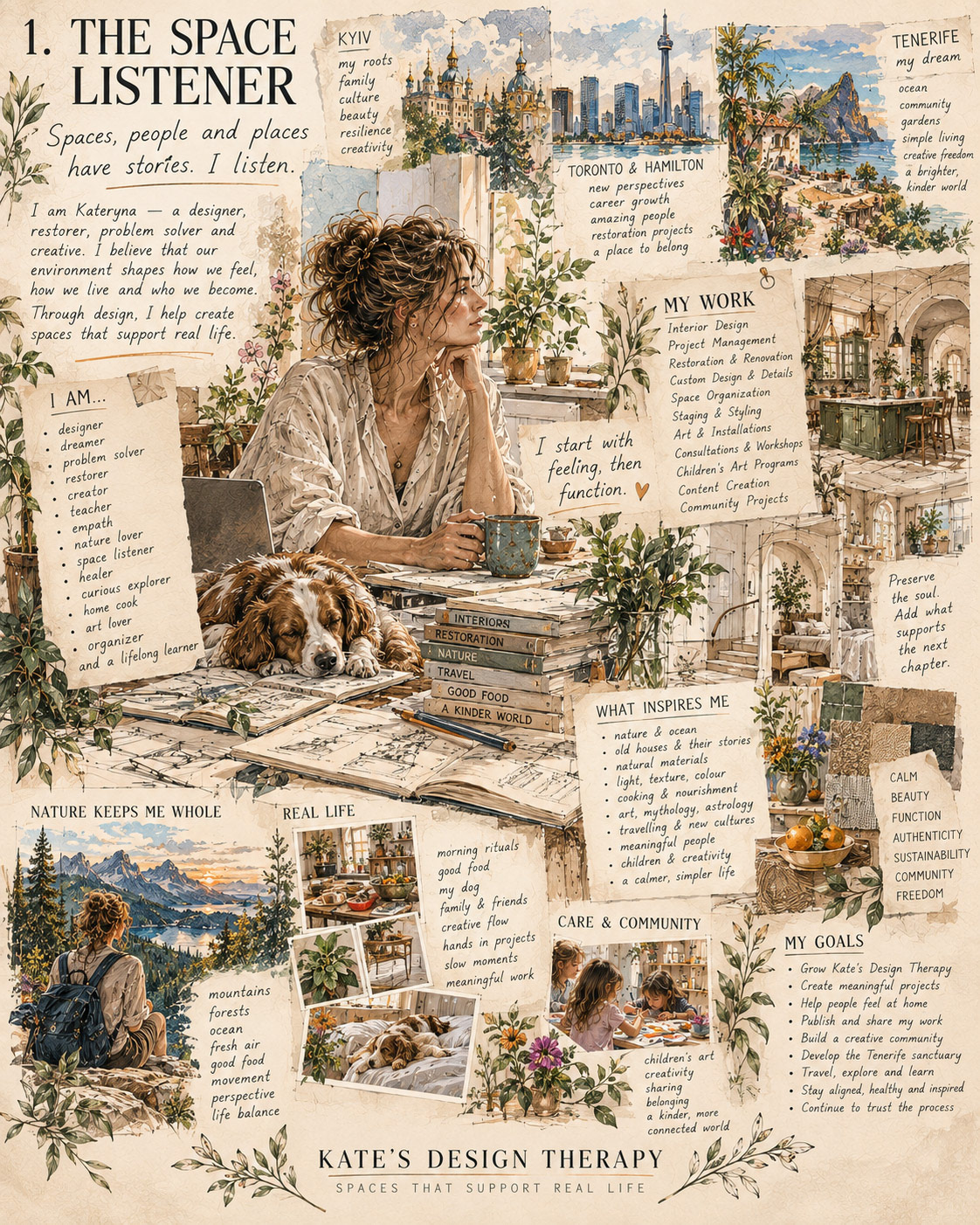
01. The Space Listener
Spaces, people, and places have stories. I listen.
I have always been fascinated by the relationship between people and their surroundings.
Growing up in Kyiv, studying art and design, working on projects across different countries, and eventually building my design practice in Canada have all shaped the way I see the world.
Every place has taught me something.
Old buildings have taught me patience and respect for history. Nature has taught me about balance. Travelling has shown me that there are countless ways to create a home, and that beauty often exists in the simplest things.
But perhaps the most important lesson has been learning to listen.
When I enter a space, I try to understand more than its physical dimensions.
I look for its character, its possibilities, and the relationship it has with the people who use it.
Sometimes a room needs more light. Sometimes it needs a better layout, thoughtful storage, or a different relationship with its surroundings.
And sometimes it simply needs someone to recognize what is already beautiful about it.
My role is not to impose a design onto a space, but to discover what will allow it—and the people living there—to thrive.
That is why I think of myself as a space listener.
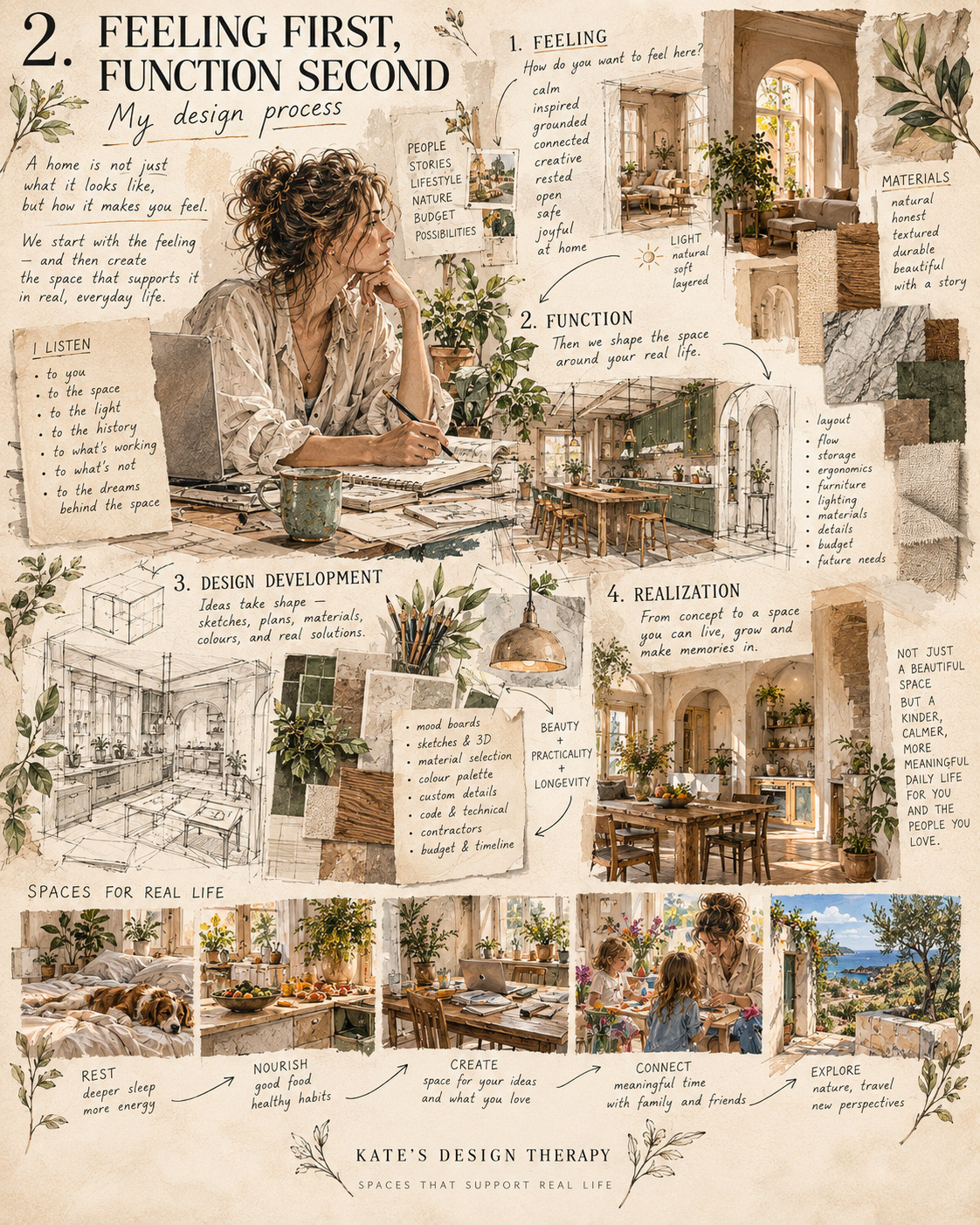
02. Feeling First, Function Second
How do you want to feel in your home?
This is one of the first questions I ask when beginning a design project.
Not what style is currently fashionable, what colour should be on the walls, or what furniture would look impressive in photographs.
I want to understand the feeling.
Do you want your home to feel peaceful and grounding? Warm and welcoming? Energizing and creative? Open and connected?
Different people need different things from their environments, and those needs may change throughout their lives.
Once we understand the desired feeling, we can begin translating it into practical decisions.
The layout determines how naturally we move through a space. Lighting influences atmosphere and how we experience different times of day. Storage can reduce visual clutter and simplify everyday routines. Materials, colours, textures, and proportions all contribute to the sensory experience.
Function becomes the bridge between the feeling we want and the life we actually live.
For me, successful design is where emotional comfort and practical solutions meet.
Feeling first. Function second. Beauty grows somewhere in between.

03. A House Is a Living Organism
How our environment shapes our well-being.
I have never thought of a house as a static object.
A home changes with the seasons, the light, the people who inhabit it, and the activities happening inside.
It wakes up with us in the morning, becomes a place of activity throughout the day, and settles into a different rhythm in the evening.
Our environment constantly interacts with our senses.
The quality of light, fresh air, temperature, acoustics, textures, spatial organization, and visual complexity can all influence how comfortable and supported we feel.
Environmental psychology explores many of these relationships between people and the places they inhabit.
I find this connection especially meaningful because it reminds us that design is not separate from everyday well-being.
A poorly organized kitchen can make cooking unnecessarily stressful. An uncomfortable workspace can interrupt concentration. A bedroom filled with visual distractions may make relaxation more difficult.
But thoughtful adjustments can create a different experience.
A home can encourage nourishment, creativity, connection, rest, and a greater sense of ease.
A well-designed home doesn't simply look beautiful. It supports the whole life happening inside it.

04. Preserve, Don't Erase
New life for old spaces. Old buildings have stories.
Their materials, craftsmanship, proportions, and imperfections carry evidence of the people and generations who came before us.
When I work with an older property, my first instinct is not to remove everything and begin again.
I look for what deserves to stay.
An original door, old wooden frames, exposed brick, decorative mouldings, or the natural patina of a material can give a space a depth that is difficult to reproduce.
Of course, preservation does not mean refusing change.
Our lifestyles evolve, and buildings must adapt to support modern needs.
The challenge—and the beauty—lies in finding a thoughtful balance between the past and the present.
This philosophy became especially meaningful during the renovation of Nightingale House, a historic home in Hamilton, Ontario, built around 1900.
The project was an opportunity to introduce new functionality while respecting the character of the original building.
Rather than erasing its history, we approached the renovation as another chapter in its story.
Preserving and restoring existing elements can also reduce unnecessary waste and help us appreciate the resources and craftsmanship already invested in a building.
History gives a space its roots. Good design gives it wings.
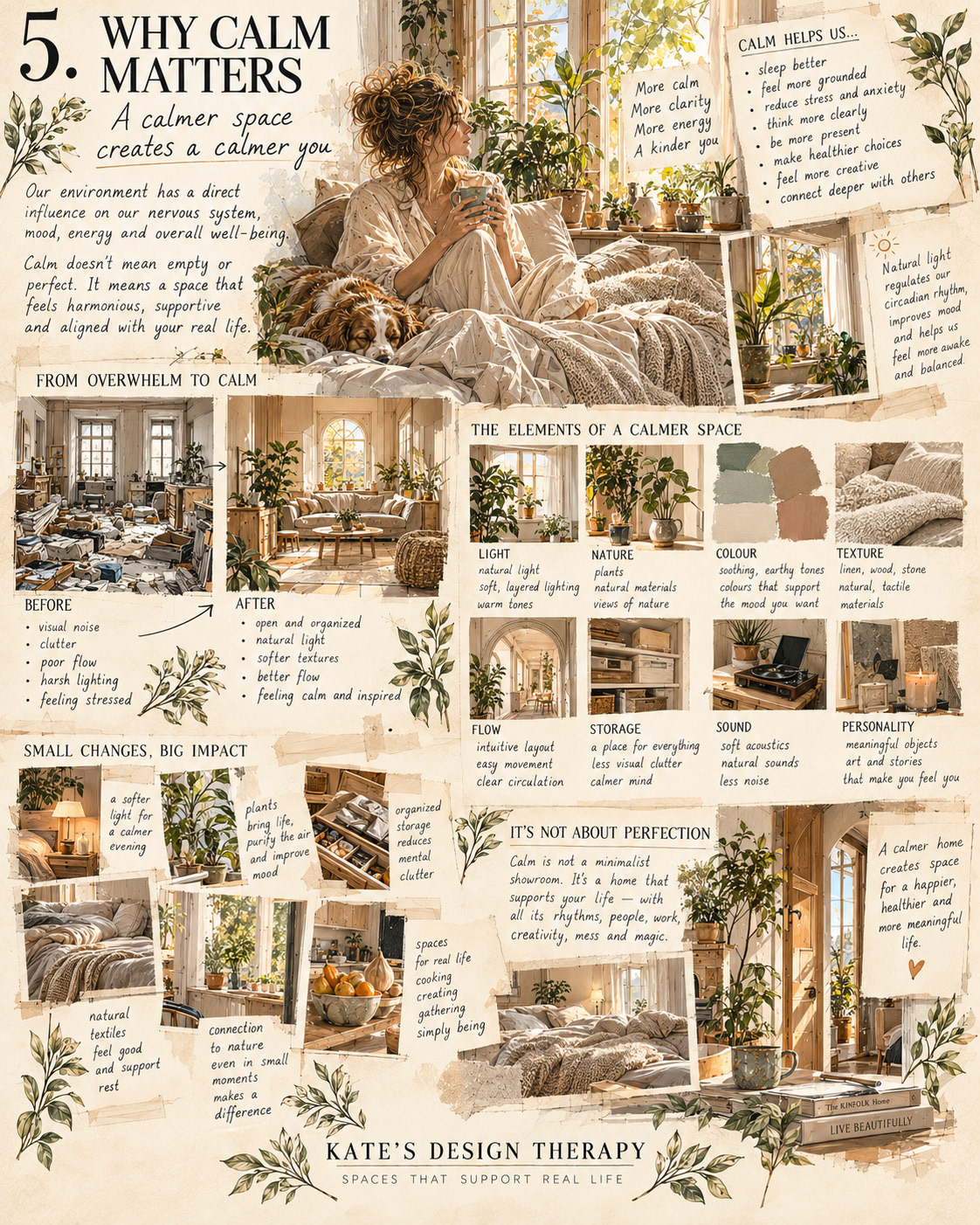
05. Why Calm Matters
A calmer space creates room for a calmer life.
When I ask people how they want to feel in their homes, one answer appears again and again.
Calm. But calm is not necessarily a minimalist interior, an empty room, or a particular colour palette.
It is a personal experience.
For one person, calm might mean a quiet, uncluttered bedroom. For another, it might be a warm kitchen filled with familiar objects, cooking aromas, and family activity.
Calm is about finding a relationship between our environment and our needs that feels comfortable rather than overwhelming.
Visual clutter, harsh lighting, unnecessary obstacles, and poorly considered layouts can create additional demands on our attention.
Thoughtful storage, natural materials, comfortable lighting, intuitive circulation, and meaningful personal objects can help create a more supportive atmosphere.
Sometimes the smallest interventions make the greatest difference.
Changing the lighting. Rearranging furniture. Creating a place for everyday belongings. Bringing a plant closer to a window. Removing something that no longer serves a purpose.
These decisions may appear simple, but together they can transform the experience of a room.
Calm is not about perfection. It is about creating an environment where we have room to breathe.
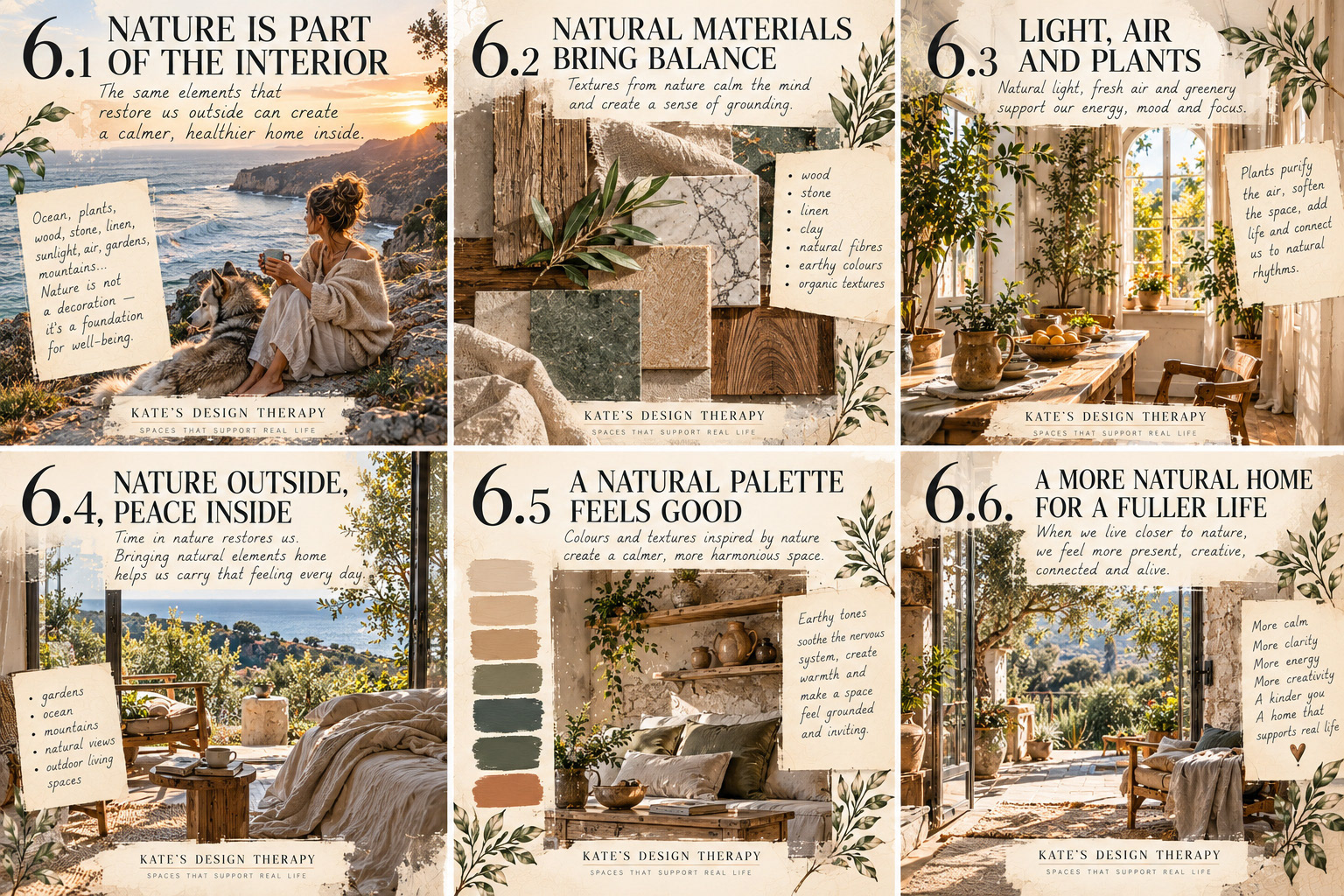
06. Nature Is Part of the Interior
We are not separate from the natural world.
Whenever I need to restore my energy, I instinctively turn toward nature.
The ocean, forests, mountains, trees, sunlight, fresh air, and the changing seasons have always had a profound influence on how I feel.
There is something grounding about touching the bark of a tree, listening to birds, watching the movement of water, or simply being surrounded by living things.
These experiences influence the way I approach interior design.
I believe our homes should maintain a connection with the natural world rather than separating us from it completely.
This idea is closely related to biophilic design, which explores how incorporating nature and natural patterns into built environments can support human well-being.
For me, this connection can take many forms.
Natural wood, stone, linen, clay, and other tactile materials. Daylight that changes throughout the day. Windows framing trees or landscapes. Fresh air, plants, gardens, organic textures, and colours inspired by the earth.
It is not simply about bringing plants indoors.
It is about allowing architecture and interiors to participate in the natural environment.
Nature is not a decorative accessory. It is part of the foundation of how we experience a space.

07. Designing a Life, Not Just a Room
A home is the background for real life.
Sometimes I think we have become so focused on creating beautiful images of interiors that we forget what homes are actually for.
A home is not a showroom.
It is where we cook, work, rest, create, make mistakes, have conversations, celebrate, and sometimes do absolutely nothing.
It is a kitchen filled with the smell of freshly baked bread.
A table covered with children's drawings.
A dog sleeping in the middle of the room.
A quiet morning with a cup of coffee.
An evening spent with friends, talking long after dinner is finished.
These are the moments that give a home its meaning.
When designing a space, I try to imagine these ordinary experiences rather than concentrating exclusively on how the finished interior will photograph.
Does the kitchen invite people to cook together?
Is there room for creativity?
Can the space adapt as life changes?
Are there places for connection and places for solitude?
A home should be beautiful, but it should also be forgiving, flexible, and personal.
It should make everyday life easier and more enjoyable rather than demanding constant perfection.
I don't want to design rooms that simply look good. I want to create spaces where life feels good.
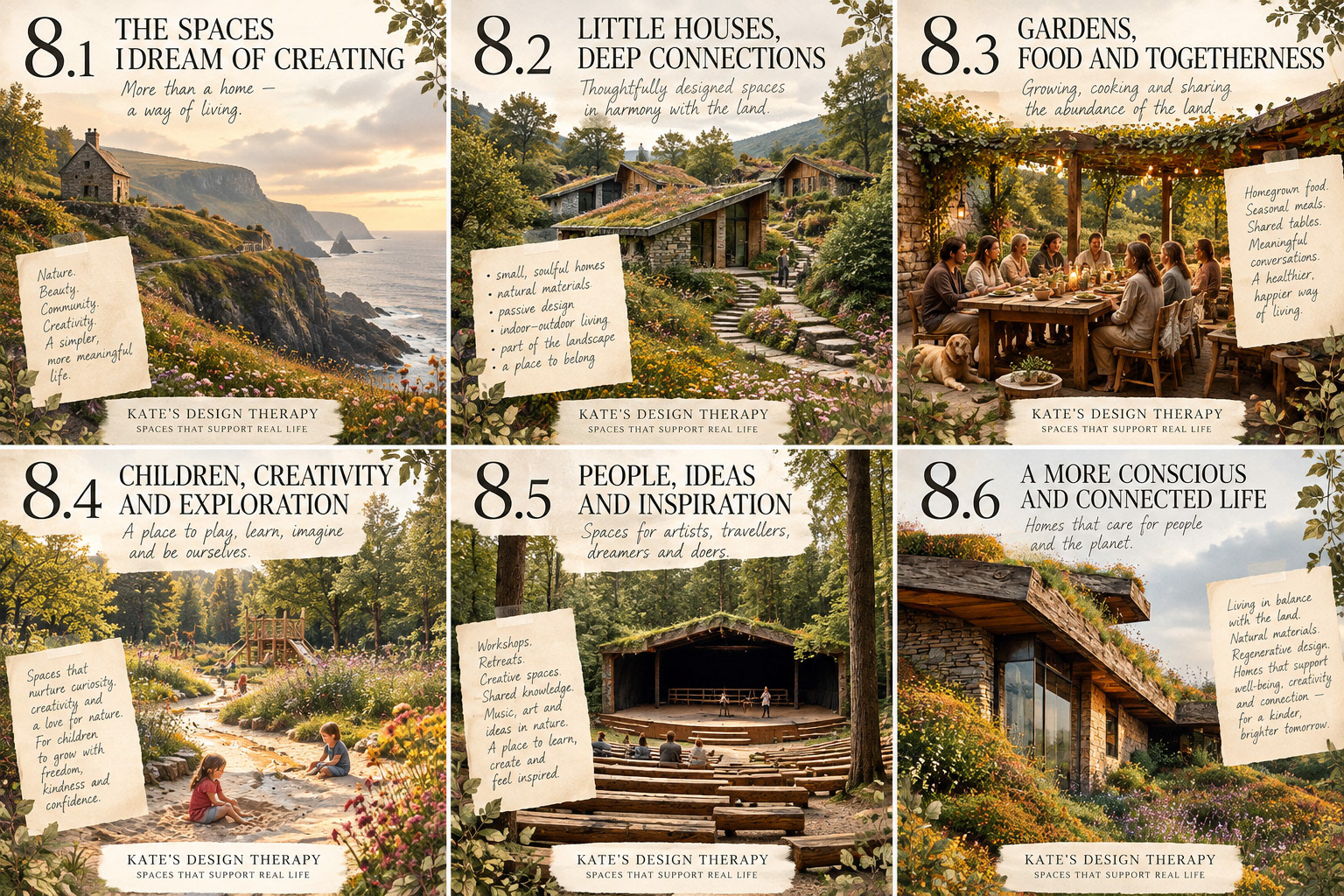
08. The Spaces I Dream of Creating
More than a home—a way of living.
Over time, my interest in design has expanded beyond individual interiors.
I have begun imagining what happens when we apply the same principles of care, functionality, beauty, and emotional well-being to entire communities.
What if our homes were designed not only to shelter us, but also to strengthen our relationship with nature and with one another?
I imagine small, thoughtfully designed houses nestled into the landscape.
Buildings made with natural materials, generous windows, and green roofs that allow architecture to become part of its surroundings.
Gardens where children can explore, learn, and play freely.
Shared spaces where people can cook, gather, exchange ideas, create art, teach, and learn from one another.
Outdoor theatres, workshops, quiet corners for reflection, and places where creativity can happen naturally.
Communities that value both independence and connection.
Where privacy is respected, but belonging is never far away.
Where architecture works with the land rather than dominating it.
I am particularly drawn to the idea of regenerative design—creating places that do more than reduce their environmental impact, but actively contribute to healthier ecosystems and stronger communities.
These spaces do not need to be luxurious or complicated.
In many ways, I imagine them being simpler.
More intentional.
More connected to the rhythms of nature.
And more generous in the opportunities they offer people to live meaningful lives.
This is the direction in which I dream of growing Kate's Design Therapy.
From creating supportive interiors to exploring how entire environments can encourage a healthier, kinder, and more connected way of living.
Because the spaces we create today shape the lives we will live tomorrow.
Beyond the Walls
Design is ultimately about life.
Looking back at these eight chapters, I realize that they are all connected by one simple belief:
Our environments should support us, not the other way around.
Whether I am restoring an old house, reorganizing a small apartment, designing a kitchen, choosing materials, or imagining a future community, the intention remains the same.
To create spaces that respect their surroundings, respond to human needs, and make everyday life more meaningful.
Spaces that feel authentic rather than staged.
Beautiful without demanding perfection.
Functional without losing warmth.
Connected to nature, history, and the people who inhabit them.
This is what design means to me.
And this is the philosophy behind Kate's Design Therapy.
Spaces that support real life.
Let's create a space that feels like you.
Whether you're looking to transform a room, restore a home, or explore a more thoughtful way of living, I'd love to hear your story.
Explore my projects and services, or get in touch to start a conversation.